Wednesday, August 31, 2016

Check Out This Video: Even an Asshole Can Save a Life

Videos that could be described as “obscene” or “offensive” aren’t particularly hard to find on the internet. Or even on YouTube in general. If they were, parents wouldn’t need to install specialized software on their computers to keep their kids from watching them, and offices wouldn’t monitor and block web traffic to keep employees from browsing something they shouldn’t be on company time.

In essence, no one would describe the internet as PG-13.

That said, one does not expect to find these words applied to a video from a non-profit. Especially one promoting organ donation. Most of the time we think of heart-breaking stories of loss, punctuated by the hope and emotional power of knowing that in death, organ donors have saved the life of someone else. Maybe a few cameos of people living new and re-exhilarated lives having received new organs.

This video I found this week definitely has those. But it also has Coleman Sweeney — the World’s Biggest Asshole:

Why I Love This Video

I love seeing non-profits, charities, and government programs go out of their way to create something special. Most videos I see, especially from non-profits, are a bit formulaic. They either share stats around their cause to appeal to the more numerically minded viewers:

Or they tug at the heartstrings to appeal to more emotional viewers:

And with good reason — these video formats work. They have been successful on television since commercials have been telling us that for less than the price of a cup of coffee per day, we can help X save Y.

But what I love about the Coleman Sweeney video is that it’s different. Donate Life America skipped the usual emotional angle and decided to play with shock and humor as ways of drawing in attention, and took it one step further by offering us an uncensored look into the life of the World’s Biggest Asshole. As Forbes breaks it down, Donate Life America has created something that appeals to a notoriously difficult group of people to engage with — millennials. And how they accomplished this goal isn’t difficult to see.

Talk to Your Audience The Way They Talk to Each Other

The real crux of why this video is so successful is because it speaks the right language. Rather than starting the video with flowery language around saving lives, the video takes a page from Dollar Shave Club’s marketing:

From the rubber testicles hanging from Coleman’s truck, to the underwear theft at the laundromat, Coleman is not your typical organ donor, and this is not your typical marketing material for a nationally-recognized non-profit organization. The video is raw, unrelenting, and to the point. Coleman Sweeney is an asshole. But even an asshole can save a life if they’re an organ donor.

Simple. Powerful. Hilarious.

While this video is an excellent example of thinking outside of the box when it comes to raising awareness about a cause, Donate Life America isn’t the first use of unexpected humor we’ve encountered in the video marketing world. While less obscene than Coleman’s story, Metro Trains commissioned Dumb Ways to Die as a method of promoting railway safety:

And in the process created a viral hit with over 137 million views, and a mobile game with millions of downloads. All in the service of keeping people from getting hit by trains. Which, you would think is a pretty simple mission. It’s a dumb way to die. See what they did there?

The World’s Biggest Asshole has created a memorable piece of content by applying the same thinking that Metro Trains used in their campaign. They spoke to younger viewers in a language that they can relate to, laugh along with, and feel connected to.

And you don’t have to be an asshole to see the value in that.

Now, normally we would end off a post asking for examples of your favorite video that relates to today’s topic. But something tells me that asking for your favorite example of “offensive and hilarious” content used in marketing will quickly have an adverse affect on our comments section. So in light of that, I would love to hear if you’ve found any other non-profits trying something different with their video marketing — swearing optional!

The post Check Out This Video: Even an Asshole Can Save a Life appeared first on Vidyard Video Intelligence Platform.


from
http://redirect.viglink.com?u=http%3A%2F%2Fwww.vidyard.com%2Fblog%2Fcheck-video-even-asshole-can-save-life%2F&key=ddaed8f51db7bb1330a6f6de768a69b8

Tuesday, August 30, 2016

17 Reasons Why Small Businesses Need (More) Video

Remember when you were in school and you took every opportunity to get free food? (Okay, maybe you still do this, I won’t judge). But at the family potluck, you’d pile your plate so high, your aunts and uncles might’ve questioned whether or not you’d eaten for the past 3 weeks.

And when you came back home for the holidays, your hands were always in the cookie jar.

Chances are, if you’re in marketing at a small business, you’ve got your hands in all sorts of jars. From product marketing to content creation, social posts to event presence, you name it: it’s on you.

So why would you want to try and video to your plate, too?

There are 17 good reasons why. But do keep in mind that if your plate is already full, adding more to it isn’t necessarily going to make for a better dinner. You’ll probably just end up with rogue mushrooms rolling around on the dining room floor.

In other words, you’ll have to learn to prioritize.

Pick things to focus your time on that are going to generate awareness, educate your customers to prime them for your offering, build demand, create shorter sales cycles, promote a free trial, etc.

Once you’ve prioritized, then it’s time to shift some things out and add video in. Why? For the following 17 reasons.

1. Get on the second largest search engine in the world

If you didn’t know, YouTube is the second largest search engine in the world. So you better be there when your potential buyers are searching. The greatest opportunity here is educational-style videos, especially since “how-to” searches are up 70% year over year in 2016.

2. Rank higher in search

While YouTube is the second largest search engine, Google is the first. Adding video to your website can increase your search rankings on Google (and others like Bing and Yahoo) significantly. The truth is, adding a video to your website actually makes a first page Google result 50x more likely.

3. Increase the understanding of your product

Sometimes products can be complex, especially when you try and describe what your product or service does in only a few sentences on your home page. Lucky for you, viewers’ understanding of a company’s product tends to increase by 74% when they watch video instead of read text.

If you don’t have one yet, a product overview video of what your offering is and the problem it solves is near the top of our list for recommended videos to start with, so you should create one of those!

4. Offer your consumers the medium they want

Today’s consumers spend more time consuming digital video than on social media: 1 hour and 55 minutes per day versus 1 hour and 44 minutes. On top of that, 4 times as many consumers would rather watch a video about a product than read about it, according to eMarketer.

Without a doubt, video is your audience’s medium of choice.

5. Boost email click-throughs

Including the word “video” in the subject lines of your emails can increase open rates by 7-13%. Plus, including the video splash screen in the actual email itself can increase click-through rates by 2x.

I feel it’s important to note here that including video in email is normally more about placing the splash screen in the email body as an image and not embedding the actual video. This is because most email clients don’t actually support inline playing of the video.

Instead, use the image that looks like a splashscreen and link out to the player on a separate page. You can even set the player to autoplay for the fewest clicks!

video in email2

6. Build stronger brand affiliation and connection

Watching a video provides both audio and visual stimulation. The mere activation of both of these areas of the brain means that viewers are more engaged and therefore naturally develop stronger affiliation and interest in the content they’re consuming. As a small business striving for that brand recognition and so dependent on loyal customers that keep coming back for more, this is crucial.

7. Capitalize on the low barrier to entry

I know, I know. You probably thought that the barriers were high, not low for video marketing. A lot of small businesses (or businesses in general, actually) think that there are high costs associated with video and a long list of equipment that just makes getting into the video marketing space so tricky. I’m here to tell you that that’s a myth. Chances are, you have a 1080px camera in your pocket or on your desk right now. Or maybe you’re even reading this post on it. All you really need to get started is this camera and some basic editing software … even something like iMovie can be all the muscle you need to get started. So play with the big kids — you’re already all set up to do so!

8. Show up more in social feeds

Social feeds (Facebook and Instagram, specifically) do a great job of showing only content that people want to see. And it’s getting harder and harder to show up there as a business. But that’s also why more and more video posts are showing up in people’s newsfeeds and why, if you create video for social, you’ll be more likely to end up there, too.

9. Create more low-touch education options

You don’t have a big team … even outside of marketing. So the more you can encourage your audience to educate themselves and help themselves throughout the purchase journey, the better — and the more efficient your sales process will be.

Video can help with this.

If you don’t have a sales team and your transaction happens online, then the faster that will happen, too!

10. Tell a stronger story

There is no better way to share your story than with video. And there’s no better way to reel buyers in than with a compelling story.

Just think of any successful Kickstarter campaign (like the two below) and consider that the videos were the starting point that boosted them to fame. But the story was the starting point even before that.

11. Increase conversions

4.8% is the average conversion rates for website using video, whereas those that don’t use video see only an average of 2.9% conversion rate.

Your website is dying for a play button.

12. Get more purchases

40% of consumers state that video increases the chance that they’ll purchase a product on their mobile device. And website visitors are 64% more likely to purchase on an online retail site after watching a video. Need we say more?

13. Track potential buyer consumption patterns

Videos linear nature means you can track how long people are watching for. You can see areas of you video that viewers re-watched or skipped. And what’s even better is if you’re using a video platform that’s integrated with your marketing platform, like Hubspot, you can see this info for each potential buyer you’re working with. Meaning you can create more targeted follow-ups or have better information on who’s interested and more likely to buy.

14. Easily create a multi-purpose asset

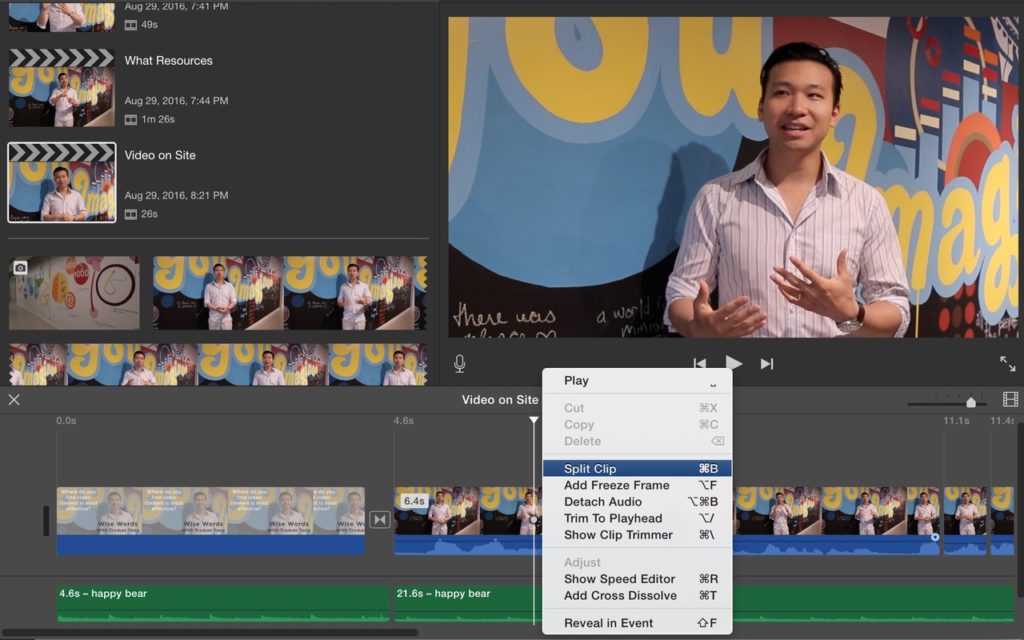
You can create one video for multiple different uses pretty easily. Film the first and then cut it up in different ways for different platforms or distribution mediums. Shorter for Instagram or maybe mash clips together for Facebook to create a teaser-style video.

You can cut it pretty easily in iMovie or other simple editing software.

Split Clip Screenshot

15. Make friends with authentic video footage

While you may think that high-budget, Hollywood-style videos are the ultimate goal, they may actually not be. And your smaller budget might actually pay off.

Today, buyers want to connect with brands and livestreamed or real, barely edited video can start to build that relationship. Without the red tape and legal restrictions behind your small business, you are one step ahead of large corporations in being able to satisfy this need.

Get your CEO behind the camera and get going!

16. Create great content in a short amount of time

All the video agencies want to tie my hands behind my back to get me to stop typing right now! But hey, not every video needs to be a masterpiece and according to point #15, those that aren’t can be phenomenally successful. The time it takes you to set up your camera, press record (or even just press record on your phone), and give the footage a quick edit is less time than it’d take you to write a short blog post. And plus, you’ll get all that extra data afterwards that you wouldn’t get from a blog post! (ahem … see #13)

Sure, there’s definitely ample opportunity for high-production value video. But it doesn’t all have to live up there.

17. Get more “bang for your buck”

Companies that use video are growing revenue 49% faster than those who don’t. That’s a compounding of a lot of the other 16 factors I listed here, but whew, is that a significant amount! Why would you want to miss out on that?

Now that you know the 17 reasons why small businesses need (more) video, just remember that it’s not only using the medium that will see you rising to stardom … it’s how you use it. Tune in next week to see the 10 ways every small business should be using video.

Want to make sure you get this post? Subscribe to our blog and we’ll send it right to ya!

Send Me the Post

Send me the 10 ways small businesses should be using video

Send Me the Post

The post 17 Reasons Why Small Businesses Need (More) Video appeared first on Vidyard Video Intelligence Platform.


from
http://redirect.viglink.com?u=http%3A%2F%2Fwww.vidyard.com%2Fblog%2F17-reasons-small-business-need-video%2F&key=ddaed8f51db7bb1330a6f6de768a69b8

Thursday, August 25, 2016

Meet the Vidyard Team, Video Style: Garth Newton

Meet the Team is our monthly chance to introduce you to the fabulous, quirky, talented people that work at Vidyard, using our favorite medium — video! For this episode, we caught up with Garth Newton, one of the QA Engineers at Vidyard. Wondering how to improve your baseball game? What the precipitation percentage means on the weather report? Well, you’ll need to watch the video then:

What Didn’t Make the Cut:

Garth had way more to say than just his unique take on burgers and baseball, so here are a few other facts about Garth:

Who is the biggest influence in our professional life?

Day to day, the easy answer is just the developers that I’m working with. I have a very high level of interaction with them, they teach me everything I know, and I do my best to teach them as well. But if I’m going to name a specific person, I’m going to have to go way back into the annals of time, and pull out one person whose name is Gary Klassen. He’s something of a local celebrity in the tech world out of the Blackberry camp as their former Principal Architect. He and I worked together on the very first Blackberry Messenger, and really taught me a lot about how I want to interact with developers. He taught me to make sure that we’re getting good ideas well before the customer sees it so we’re making good things and we’re making good things really, really well. Mr. Klassen, this one goes out to you!

What’s your favorite video on the internet right now?

I cheated and saw these questions before hand, and I kind of cheated again because I don’t have just one favorite video. I actually use video on the internet as a form of entertainment and information gathering, so I watch a lot of Netflix and a lot of MLB.tv as I’m a huge baseball fan. So day-to-day my favorite video is probably the one I just watched and was entertained or informed by. It’s really hard to narrow it down to any one.

And here’s how to find Bobby O’Brien’s in case you want to sample the burgers:

I’m partial to the Cajun Spice one myself.

The post Meet the Vidyard Team, Video Style: Garth Newton appeared first on Vidyard Video Intelligence Platform.


from
http://redirect.viglink.com?u=http%3A%2F%2Fwww.vidyard.com%2Fblog%2Fmeet-vidyard-team-video-style-garth-newton%2F&key=ddaed8f51db7bb1330a6f6de768a69b8

Wednesday, August 24, 2016

Are You a Master Video Marketer? Find Out in This 2-Minute Assessment!

If you’re reading this post, you’re probably already using video.
We’d even bet on it.

But that’s not really a big bet to take when 87% of online marketers use video today and 96% of B2B organizations are leveraging video marketing content.

The only thing is, ‘using’ is a pretty loose term. There’s a broad spectrum in the use of video in marketing. There’s a big difference between publishing videos here and there to YouTube (which, hey – no objections here, you’re definitely on the right track!) and generating leads or tracking ROI from video.

Think of it like this: while cracking the egg is the start to any good breakfast, an explainer video on your homepage that lays out all that you do and the problems you solve is the start to any good video marketing strategy. But it is just the start. An uncooked, half-cracked egg never tasted that great. (Okay, to be honest, we haven’t tried).

What Does a Master Video Marketer Look Like?

Beyond creating an explainer video and posting it to your homepage or a thought leadership piece to YouTube and counting the views, there are so many ways to grow. Things like:

  • Getting executive buy in where management truly believes in the power of video and that it can really move the needle in their (and your!) business … and also leveraging this buy in to secure consistent and recurring budget for video marketing.
  • Building brand guidelines specifically for video content and creating re-usable brand assets for a consistent look and feel for all your videos
  • Mapping your video content to your buyer’s journey and creating video content for different areas of the funnel. Plus using in-video CTAs, forms, and other events to help viewers move easily from one video to other content.
  • Expanding your marketing tech stack to include a video marketing platform and even integrating it with your marketing automation platform or CRM so you can track individual viewing behavior on a lead-by-lead basis.
  • Aligning with your sales team on a monthly basis to understand what content would enable their sales conversations and then consistently creating those videos to support them.

… and that’s just a taste!

What does it really take to be a best-in-class video marketer? The Video Marketing Maturity Model can tell you.

Start Assessment

Take this 2-minute assessment to rate your video marketing maturity!

Start Assessment

The Video Marketing Maturity Model

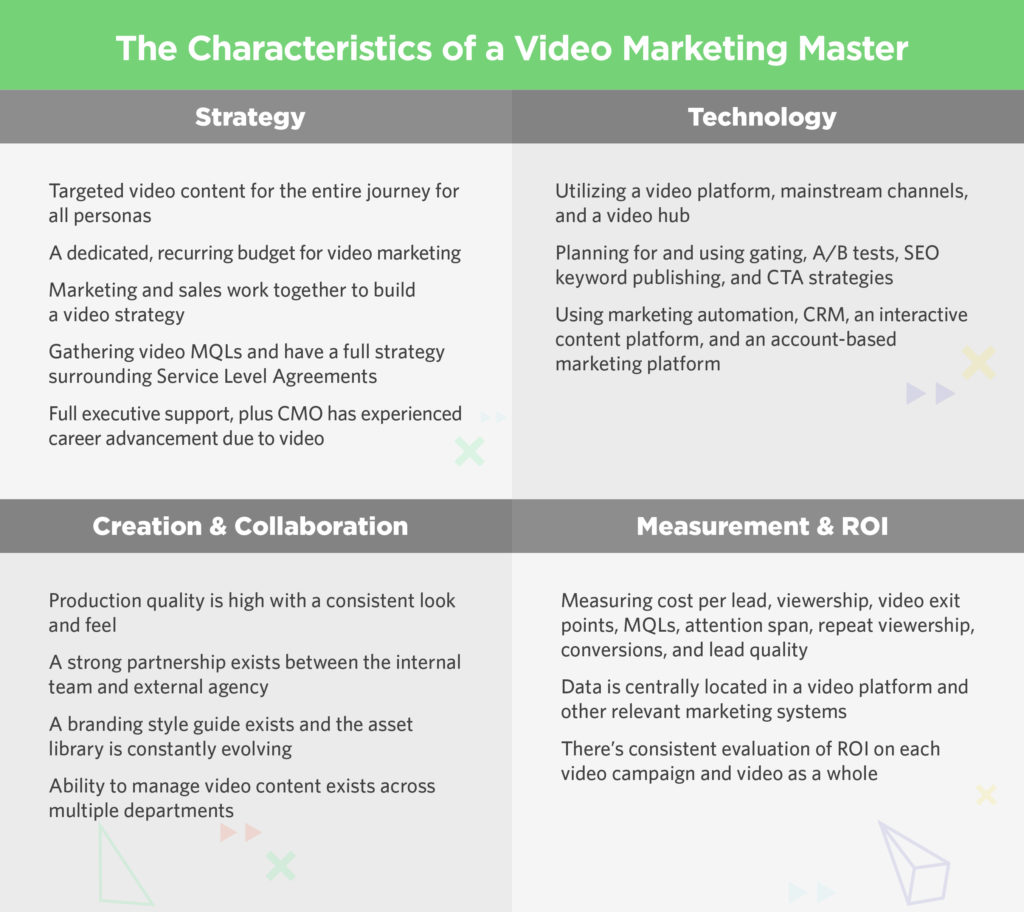
In the Video Marketing Maturity Model, a framework created by both Vidyard and Demand Spring, we outline the characteristics of video marketers at varying levels of maturity along four different categories:

  • Strategy
  • Technology
  • Creation and collaboration
  • Measurement and ROI

Why? Because the best way to grow is to know where you should be growing to. By benchmarking yourself against other video marketers, you can see if you’re a Beginner, Intermediate, Professional, and Master. … Plus, see where the opportunities lie for you to move to the next level.

Master video marketers are the cream of the crop. They have the following characteristics:

Master Video Marketing

Do you think you’re a Master Video Marketer? (It’s okay to say ‘maybe not’). Either way, take the 2-minute assessment to evaluate your current video marketing efforts, see your maturity ranking, and receive custom recommendations on how to improve and move to the next level.

Get crackin’!

take the video maturity assessment


Brendan McCrann
Brendan McCrann

Brendan is the Manager of Video Marketing at Demand Spring. With an extensive education in marketing and digital experience, Brendan is a hands-on creative type who brings a unique combination of video production and marketing consulting skill to every client engagement.

The post Are You a Master Video Marketer? Find Out in This 2-Minute Assessment! appeared first on Vidyard Video Intelligence Platform.


from
http://redirect.viglink.com?u=http%3A%2F%2Fwww.vidyard.com%2Fblog%2Fbeginner-master-video-marketer-2-minute-assessment%2F&key=ddaed8f51db7bb1330a6f6de768a69b8

Tuesday, August 23, 2016

5 Types of Webinars You Need to Fire Up Your Webinar Program

Hands up! As a marketer, how often have you struggled to come up with new ideas to engage your prospects? If your hand is not up then you’re either a marketing guru, or you might want to look down to make sure your pants aren’t on fire.

I like the pants I’m wearing today, so I’ll be honest with you. At Vidyard we put a great deal of effort into keeping things fresh and trying new ideas. It’s definitely not always easy! Sometimes we struggle to find new topics for webinars or figure out what format our viewers prefer. I’m sure that this isn’t just be a problem for us – after all, we’re all in the same boat here!

So if you can relate to the feeling of searching high and low for new ideas for webinars then we have just the thing for you! We’ve put together a list of five tried-and-true webinar types to keep your webinar strategy feeling fresh and your viewers on their toes.

1. Panel Webinars / Fireside Chats

Panel webinars are one of our new favorite formats here at Vidyard. Panel webinars (or the more casual fireside chat) consist of one host who interviews a panel of 2-3 experts or thought leaders about a certain topic. The webinars are informal and unscripted, and most even allow attendees to ask questions throughout the session. It’s a highly engaging form of webinar and adds credibility to your brand by inviting partners and customers create a thought leadership piece.

TIP: Logistically, panel webinars are best done with software that allows you to broadcast everyone’s webcam at once, like Google’s Hangouts On Air (soon to be YouTube Live) or GoToMeeting.

2. Educational Webinars

They say the brain processes visual information 60,000 times faster than text, so it only follows that webinars would be used for educational purposes, right? This is the most run-of-the-mill webinar format that everyone and their Mom is using — but that doesn’t mean it doesn’t serve a purpose! Educational webinars that primarily rely on slides to convey information are a great way to educate people, and much like panel webinars, it’s also a great opportunity to include external speakers like customers and partners.

TIP: The only drawback of education webinars is that they can be un-engaging for prospects if they’re asked to stare at a slideshow for ~60min, give or take. To keep engagement up consider adding in polls and videos, or even breaking up your webinar into shorter 15-25min sections. Just whatever you do, make sure to keep your product out of it!

3. (Keynote) Presentations

Presentation and keynotes are often recorded at events and are prefect fodder for webinars as well! You can live stream them the day of, collect registrations on your homepage, and also keep the recorded version on your website after the event is done. Events are time consuming and expensive, so this is a great way to make the most of them without much added effort on your part.

TIP: One of the best parts of re-watching keynote presentations is that you can cut out all of the … “fluff”. If you’re able to, remove the parts that detract from the presentation, like the presenter shuffling up to the podium, barely audible questions from the audience, and even possibly the frame itself if there are visual distractions.

4. Product Webinars

Product webinars, as I’m sure you can discern from the name, are product-centric and go over general or specific points of your products. This is your time to get as braggy as you want and show off all the neat features of your product without holding anything back! General product webinars are fantastic for later stage prospects who are looking for more in-depth information about your product, and also have the added bonus of taking the pressure off of your sales team to perform demos. Specific webinars can even help keep your existing customers happy and engaged by helping them get acquainted with new products or features.

TIP: If you’re just going to present slides about your product then you are in for a snooze-fest, so make sure you have screen sharing capabilities (especially if you’re in the software or high tech market), or break things up with some videos.

5. On-Demand Webinars

We couldn’t write about webinars without mentioning their recordings now could we? On-demand webinars are any of the above webinars in their recorded format. It’s estimated that 42% of registrants never end up watching the actual live presentation, so it’s important to not only have the recording available for them afterwards, but for anyone else who finds their way to your site and is interested in consuming content.

TIP: People are inherently busy, so it’s important to keep on-demands succinct or else you’re in danger of turning off your viewers. Consider getting someone savvy with video editing to chop down your webinar to a shorter version if it’s over 30 minutes, or even split up your webinar into chapters so viewers can quickly scan to find exactly what they’re looking for.

And that brings us to the end of our list! Do you have any other webinar tips? Or maybe you’re running a whole other type of webinar? Leave us a comment – we’d love to hear from you!

The post 5 Types of Webinars You Need to Fire Up Your Webinar Program appeared first on Vidyard Video Intelligence Platform.


from
http://redirect.viglink.com?u=http%3A%2F%2Fwww.vidyard.com%2Fblog%2F5-types-webinars-need-diversify-webinar-program%2F&key=ddaed8f51db7bb1330a6f6de768a69b8

Monday, August 22, 2016

The Making of Vidyard’s New Website Product Tour Videos

Recently, Vidyard quietly launched our new website. We didn’t want a lot of fanfare, but we knew it was time to deliver our customers something new and valuable.The previous site had been fairly stagnant for a while, and our product and story had evolved so much that it was time to revisit, readjust, and put our best foot forward so we could deliver to our customers what they deserved: something exceptional.

Being who we are, and believing so strongly in the power of video, we knew that video would have to be front and center in how we told our story and explained our product to our website visitors. We created a homepage video, of course, but that wasn’t enough. Our previous website had included a series of videos that we refer to as our “Product Tour”. Analytics proved that the videos were quite successful, so we were all game to replicate the approach. We needed to create a video tour that could help website visitors quickly and easily understand our newly reimagined, complex product: The Video Intelligence Platform.

So how did we create this product video tour? Let’s walk through what went into pre-production, production, and post-production to really get a look at what was involved.
 

Pre-Production


The message

First things first, a video needs a message. It needs a story. Yes, even a product video (or videos). We could say, “Well, our platform has this feature, and it has this button and this button, and if you click over here, this happens.” But what does that really mean to the end user?

In our case, a major factor in the message of our product video was that there wasn’t just one user of our product. Where at one point in our history (fairly recently, actually), we were focused solely on helping marketers achieve their goals, now our audience had expanded to what we call “three lenses”: marketing, sales, and internal communications. These lenses would all use our product in different ways, so how could we talk about the product without confusing one audience group, or excluding another?

We did it by focusing not just on the “features” of our product, but on the “benefits” of the Video Intelligence Platform. We knew that no matter which audience group or “lens” a viewer belonged to, they all shared similar goals: chronologically speaking, they needed to:

  • “Manage” their video assets so audiences can experience it (including sharing them on websites and social media),
  • “Optimize” the video content to move audiences through a journey (with options like A/B split testing, calls to action and email gates),
  • “Analyze” its performance to find out what content is working and what individual viewers are interested in (with detailed analytics on both videos and viewers), and finally,
  • “Act” on all this data to get strong business results (by integrating it with the tools they already use).

All of the features of our platform could fit into one of these four benefit quadrants, which helped shape and solidify our message: one video per quadrant, plus an introductory video to, well, introduce our three lenses to the Video Intelligence Platform. Five videos in all would make up our new product video series.


Concept

A homepage video may be a great opportunity to bring your company’s brand to life, and get creative with how you tell your story and really wow your audiences. A product video, however, needs to be direct, and packed full of the necessary ‘meat’ to help your audience easily understand your product (all while being concise enough to hold today’s short attention spans). That’s how they’ll walk away knowing if they’re interested, if you can give them what they need (or want), or if they should look elsewhere.

So we knew we didn’t want complicated scenes props, shots, lines…we wanted a clean, modern experience so nothing would overpower or take away from the message that we needed audiences to absorb. Being a software company, we don’t have a tangible product to admire the look and touch of, and we didn’t want to sit an actor at an office desk in front of a monitor either.

It didn’t take long to settle on our the final look and feel of our videos. There would be one actor (per video) on a white ‘cyclorama’ stage (a curved white backdrop that gives the visual impression of no walls or floor – essentially a minimalistic, floating white space), accompanied by minimal props.  The user interface (UI) of our product would be shown either on a laptop screen, or ‘floating’ in midair (the two UI options would offer visual interest throughout the video series).


Script

We had the message and concept down; next we needed the scripts. Video scripts are, of course, different from other communication mediums. They can’t be written the same way a webpage or brochure or other marketing collateral is done. Why? Because hearing someone say something is very different from reading it on page.

in line with our brand personality, the tone had to be intelligent, yet conversational and friendly. Scripts should be even more conversational and colloquial than other mediums, and sentences shorter, so the viewer feels a sense of personality from the person on screen, like they’re chatting in real life.

Ever sat in a university lecture hall and tried to absorb and remember everything you hear without writing it down? Video is perfect for conveying complex ideas because your viewers can see and hear you. We knew that the scripts shouldn’t be all buzz words, with our actors saying things like, “If you click here and then scroll down you’ll see this…” We could keep the actors’ dialogue direct and simple, and use the UI on screen to display the complex details of our product.

In one video, for example, we talk about our analytics, and what kind of information the viewer gets out of it. We could have made this too complicated and detailed to remember, but instead, the dialogue and UI balanced each other out perfectly:

“You’ll get incredible insights on what each viewer really thinks about you. Think of it as digital body language.”

Now here, instead of talking about engagement graphs and color-coding and all the other details, our actor simply said, in everyday language that viewers will understand and remember:

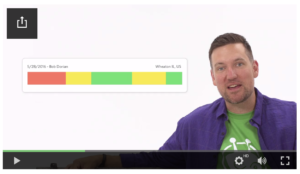
“You’ll know if they’re kinda interested, leaning way in, or turning away. You’ll get their true, honest reaction.”
Screen Shot 2016-08-21 at 4.51.03 PM

On screen, the UI depicted the engagement graphs and indicated different levels of each viewer’s interest. The actor’s language gave a human element to the product, helping viewers understand the benefit of the engagement graphs in terms they could relate to.

This all had to happen quickly, as well. These types of videos are best if kept around the two-minute mark so they’re easily digestible and memorable. It’s why we created a video series – not only does it divide the content into manageable, related chunks, it makes sure people don’t feel they have to sit through an hour-long sales pitch, and if they want, they can even skip to the videos they want to re-watch.


Storyboarding

Scripts provide the words, but what are the actions? That’s what storyboarding is for. Once the scripts went through a number of rounds between the Director of Product Marketing, the CMO, and the Brand and Creative Manager, the scripts were passed to the Creative Director and Video Production Manager, both of whom are experts in bringing a video script to life.

How do you bring a video to life that you’ve already made the choice will have a blank, clean set, minimal props, one actor, and some UI? How do you make it visually interesting? “Talking-head” style videos, with a person’s head being the sole focus of a video, is considered outdated and completely unengaging. So our two video wizards drew up what every single shot would look like for all five videos: where each person would stand or sit, if there would be any movement, and even what posture they would have to provide the best composition.
2M6A0574

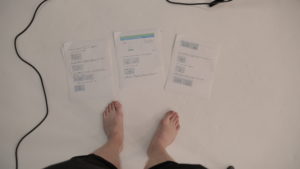
The director reviewing the script and storyboard on set. Notice the bare feet – shoes weren’t worn on the white cyclorama set to avoid any dirt and scuffs.

It had to be determined at the storyboarding stage where UI would appear on screen. Not just at which parts of the dialogue, but literally where on screen. If the user interface that was being talked about was more detailed and complex, it would likely need to take up the whole screen so viewers could see and understand it clearly. If the UI could be pared down to be understood at a minimal glance, it could share the screen with our actors.

With placement of UI covered, how would it animate on screen? The style of the videos were clean and modern, while providing detailed information so it was important to keep the effects clean, as well. No flashes and booms and screens dancing their way onto the screen and off again. Even these details aren’t too small to plan, because every aspect of a video can help make or break attention span, engagement, and retention.


Casting

Casting can be a fun part, because it’s the first stage where the video feels like it’s beginning to jump off paper or screen and become human and relatable. Our product tour videos featured not paid actors, but Vidyardians. Why? Two reasons: first, it was important from a brand and culture perspective that our own employees, who understand and love the company and our product, were included in the videos. Secondly, and candidly, we knew using our own actors would keep the budget lower than if we had hired professional actors for five videos.

But we didn’t just pick at random. A few things we considered: of course we wanted diversity in our casting. Both men and women play an equally vital role in our company’s success, so it was only right that both were featured prominently in our videos. Our cast members included both senior and junior, veteran Vidyardians and new, from different teams, so each person would bring their own personality and love of Vidyard into their video.

When casting non-actors, especially for videos like our product tour which would be hosted on the website long-term, we decided to hold on-camera auditions. Someone may be hilarious in person, or tell great stories, or have great posture, but something magical happens when a camera is turned on inexperienced actors: it turns the most charming, eloquent people into bumbling, stuttering messes. The auditioners were given chunks of script to memorize and speak to the camera, and let’s just say there are quite a few interesting outtakes on our Vidyard cameras and hard drives. But five great performances stood out from the crowd, and their faces and personalities are now helping to bring Vidyard’s product to life.


Production


The studio

Vidyard’s office includes our very own in-house studio. However, it’s fairly basic, and we knew for this project, our studio wouldn’t cut it. We needed something bigger, so the video experts could move around lights and cameras to zoom out far enough to get actors and UI on screen. We wanted the clean white ‘cyclorama’ environment as well. So after some research into location, availability, and budget, we booked a studio in Toronto for three days of shooting that would offer everything we need. It was a very large stage with bright overhead lights and a cyclorama that was painted freshly off-white at our request so we wouldn’t have to do too much editing or use any green screen techniques. Fun fact: these studios are tons of fun – standing in the ‘corner’ of the rounded cyclorama makes you feel like you’re floating with no sense of wall, floor, or ceiling.
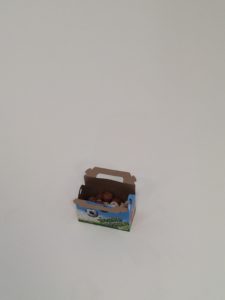
 

IMG_0988

Timbits, purchased for snacking during the drive to the studio, look as though they’re sitting in space.


Props and wardrobe

There were a few things needed on set that we brought ourselves with a small moving truck: the few props we used, including a bench, small table and some chairs, and a couple little items for visual interest. We included different furniture and small props in each video to add personality and uniqueness to each. It was also important to us that each video didn’t feel like it was just a regular old office; our brand is unique, fun, and creative, and we think our customers are too, so these interesting furniture choices would help our videos feel more relatable and engaging.

We contemplated having our employee actors dress in their own clothes, or keep them in our official green Vidyard t-shirts with our newly redesigned logo emblazoned on them. Did we want them to express their own unique personalities, or did we want them to create a unified picture of Vidyard and the brand traits that go along with that? After many enthusiastic rounds of Rock-Paper-Scissors (kidding!), we decided on both: the actors would wear Vidyard t-shirts to represent us, our brand, and V-Bot our trusty mascot/logo, but they would all wear individualized pieces with the t-shirts, whether a sweater, plaid shirt, jacket, or even statement necklace. That way, all the videos feel unified yet offer a sense of fun individuality – after all, our customers are all unique, and we wanted to speak to them on a human, relatable level.  

2M6A0628

One of our newest Vidyardians wearing just a t-shirt to show off the Vidyard logo, and jazzed up with a necklace and glasses.

2M6A0613

One of our veteran Vidyardians, showing off a hint of V-Bot underneath this own (still brand-appropriate) shirts.


The crew

The phrase “too many cooks in the kitchen” can definitely apply when creating videos, so we kept the crew on set small: our Creative Director and Video Production Manager handled the equipment and directed the videos, while the Brand and Creative Manager (me!) acted as script supervisor on set to help the actors with line delivery and accuracy.
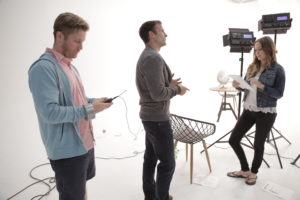
2M6A0646

Going over lines with one of our actors while his microphone is being set up.


The tech

Since we were shooting these videos ourselves without help of an agency, we had to have the right tech to do the job, including camera, audio, and lighting. Equipment that is more capable helps production go more easily and smoothly, and and makes editing easier afterwards.

Previously, we had been using Digital SLR cameras, which produced an image at a maximum of 1920×1080 (1080p) resolution. They didn’t create the most “data-rich” encoded files, which complicates editing, especially colour correcting and grading – for example, think about it this way: a rainbow of only red, yellow, and blue won’t give you the visual richness of one that also includes the mixed shades or orange, green, and purple. We needed a camera that would allow us to control and pull out what we needed. So we purchased a camera that gives us a 4K video resolution, and richer “8 bit 4-2-0” encoding. Bonus? With this new camera we could still use the fairly inexpensive SD cards for storage to save on some of the investment costs. It’s always important to have an idea of what you want your end product to look like so you know what your tech limitations or opportunities are.

We also had a fairly new set of three Ikan brand LED lights that gave us the flexibility to adjust colour temperature and brightness by using dials. These lights are lightweight for travel and easy setup, and function well on most small-medium scale productions. When picking a studio, we selected a space that had pre-hung lights for the white cyclorama backdrop so when we came into the studio all we had to do was work out our actors’ exposure in comparison to the preset background lighting to achieve a nice bright white scene.

For our audio equipment, we had to keep in mind the studio and the crew. We used a hidden Sennheiser G3 lavalier microphone over our Rode NTG-3 shotgun microphone since we didn’t have an assistant to hold a mic boom, and, just as importantly, we didn’t want to scuff up the white floor of the cyclorama set with a stand. It’s good to keep in mind all aspects of a shoot when selecting your tech, because each facet of a shoot can impact others.


Post-Production


Editing

After shooting wrapped, the video team focused on polishing up the video footage into our new, snazzy video tour. Full productions can be great because they remove a lot of the guesswork that can happen for a live or unplanned video.Since everything was planned out beforehand, the video experts just needed to follow the script, and place on the storyboard ‘timeline’ the best takes for each scene.

To get a completely polished and clean look, the videos needed to be color corrected because the default doesn’t offer a visually rich experience. The color representation had to be accurate and not too creative because our actors were were wearing t-shirts in our branded Vidyard green. The white background was cleaned up to remove any scuffs from shooting (we kept our shoes off during the three shoot days, but scuffs and dirt still happen!). And, as simple as it sounds to achieve a white background, there are various “flavors” of white you can aim for. Some people shoot videos that have their white tones lean towards a yellow-ish tinge, but we chose blue-ish white as it’s typically perceived to give a more crisp, clean, and professional appearance.

Even default audio isn’t quite good enough for a rich sound. We levelling our actors’ voices to the music, and added some mild bass and resonance to create a more “full” tone. Proper audio levels are an often overlooked piece of the editing puzzle, especially if someone is new to producing video content. It is just as important to have great sound as it is to have a great image to look at.Otherwise, an actor’s voice mixing too much with the background music can inadvertently cause viewers to tune out and not retain information.
 

Music

When selecting music, our video experts looked at multiple music sources to find an appropriate song for a fair price. What else went into music selection? The song needed to fit with our brand – friendly, engaging, modern, fun but not too wacky, professional and intelligent. It needed to not overpower our actors’ voices, but offer a good pace – too slow can bore viewers, and too fast can make viewers feel almost anxious. A song that’s well-paced with script can help entice people to want to know more and keep listening.
 

Design elements

User interface shots needed to be designed for each video. Many UI images aren’t a direct screen grab from our product because often, a product shot includes a lot of content, and, while important for function, can feel too visually cluttered when you’re looking at it quickly for the first time. So the graphic designers worked to polish up the images, minimize clutter, and display only the pertinent information that was talked about. If UI would be shown on a laptop the way a Vidyard user would experience it, the right image was carefully curated and shown in all its detailed glory to give the impression that Vidyard itself is rich in detail and information (because the more information our users get, the better and more informed their decisions will be!). The final effect is a crisp, modern design that keeps visual interest while informing viewers.

There you have it! As you can see, a fair bit goes into creating a product video series, but it’s all worth it! With detailed planning, creativity, technique, and a lot of willingness to have fun, you can produce a great product video (or 5) that will wow your audience and turn them into customers.

IMG_0992

The crew on route to set, getting hyped up for a long shoot day.

Check out our product tour yourself and let us know what you think!

The post The Making of Vidyard’s New Website Product Tour Videos appeared first on Vidyard Video Intelligence Platform.


from
http://redirect.viglink.com?u=http%3A%2F%2Fwww.vidyard.com%2Fblog%2Fmaking-vidyards-new-website-product-tour-videos%2F&key=ddaed8f51db7bb1330a6f6de768a69b8

Thursday, August 18, 2016

10 Things Marketers Can Learn from Videos of the Olympics 2016

Are you an Olympics fan? Are we in the Circle of Trust where I can be honest? I’ve never been one. Gasp! I know. But before you judge me too hard, yes, I’m patriotic, and yes, I think the athletes are insanely talented and driven and exemplify so many qualities that help make the world a better place. But I’ve never made it a priority to watch a significant portion of any Olympics games. Why? Sports.

sports

I’ve never really loved watching any sports; I’d stick my nose in a book over watching a Super Bowl, Stanley Cup, or World Cup game. But this year, something happened. Maybe it was that there’s a giant TV mounted on the wall right near my desk, so for the past few weeks my coworkers and I have been “working” while admiring the mind-blowing fitness and finesse of the world’s top athletes. I mean, seriously. Wow.

Maybe it’s also the power of the stories that have surrounded, and been created by, these Games. Whether we’re talking commercials by some top brands, fan-generated content, or actual footage from the competitions, the 2016 Olympics have been a treasure trove of inspiration, lessons, and fun.

With the Closing Ceremony happening this Sunday, let’s take a look back and discover 10 things we, as marketers looking to craft stories, engage audiences, and win customers, can learn from some of this year’s Olympics videos:  

(Or, at a bare minimum, let’s just sit back and enjoy some awesome videos!)

Lesson #1: The heartstrings are always ready to be pulled

It’s not just about who crosses the finish line first—every athlete came from somewhere, worked hard, failed, triumphed, loved and missed their families. Proctor and Gamble knows that love is a universal, relatable message, and it attracts audiences almost like nothing else. For at least a few years the company has touched the hearts and jerked the tears of many with their ‘Proud sponsor of moms’ campaign. Check out athletes receiving and appreciating the support of their moms.

Every time I see one of these campaign videos, I’m touched. But personally, as a viewer part of me wishes the message was more inclusive: what about all the fathers? Aren’t children (and the athletes) raised, loved, and supported by paternal figures as well? As a marketer I thought, just because something works doesn’t mean it can’t be better. About five minutes later, it was like Minute Maid heard me when I came across this video:

Maybe it’s shrewd marketing, and building on the success of the P&G campaign, but it worked on me!

Lesson #2: Tailor your story to your personas

Any marketer knows, marketing isn’t one-size-fits-all. So even if you create a powerful story, that doesn’t mean everyone is going to be touched by it.

Take Proctor and Gamble. The company is huge, owning many brands like cleaning products, beauty products, laundry and dish soaps, feminine products, baby products…the list goes on. Many of P&G’s products are focused in the ‘domestic’ realm, which traditionally is still seen as women’s realm. Which would explain why P&G’s overarching Olympics campaign (referenced in Lesson #1) is focused on mothers and love—so feminine and sensitive, right?

Contrast that directly with Gillette, another of P&G’s brands, that has a tagline of ‘Gillette…the best a man can get’. The company didn’t run the same ‘Mom’ campaign and tack Gillette branding at the end of it. Instead, a new video was created that appeals to traditionally masculine qualities: adversity, bravery, fighting, winning, standing on one’s own and not needing support:

Pretty different, right? It feels almost vicious and gruesome (feral dogs and vomiting, anyone?) in comparison. The suggestion seems to be that these manly athletes are driven by internal forces, rather than externally by their support system in the ‘Mom’ campaign. Same company, very different messaging and approach. No matter what you think of the ads, it’s undeniable that P&G is definitely working hard to connect with their unique audiences instead of serving them the same.

Lesson #3: Even when your product can’t relate, your brand can

You know what I think of when I think of athletes dedicating their whole lives to physical prowess and achievements? Why, junk food, of course.

When something big is happening in the world, we as marketers don’t want to miss out. But what if our product doesn’t at all fit into the story? That’s where we can think about our brand, who we are and what we stand for. Even if you’re Coca-Cola, and your product is an unhealthy soft drink that offers no nutritional value, you can still use positive brand themes, like friendship, and making lifelong memories, to get into the game…or, should I say, the Games (see what I did there?).

Hershey’s takes a similar approach. As much as we (or I) looove chocolate, it’s hard to imagine athletes binge-eating the sweet treat, so how can it join in the narrative of the Olympics? Well, chocolate makes us happy, we share it with the ones we love, right? And happiness is universally sought after and cherished. With the tagline, ‘Hello Happy. Hello Hershey’s”, the company can easily get in the game.

Lesson #4: Think beyond the big moment to how your message will last

You know what’s amazing? Brands, messages, and stories that have staying power. It’s one thing to jump in the game and try to get your voice heard over the din when something big is happening. But some of the most provocative and impactful stories happen when marketers (or the story’s creators) think about the bigger picture.

Take Always, for example. The brand represents feminine pads. It could make a video about how it protects female athletes during the games. Which sure, is important. But is that the biggest, most impactful story the brand could tell? How about this one, instead, that was featured during this year’s Olympics:

It’s true that the Olympics host men and women athletes, show off their strength and skills, and recognize both sexes for their achievements. But the Olympics may not be a true reflection of everyday life, where the phrase “You throw [or do anything] like a girl” is typically still used as an insult.

The beauty of this ad is it suggests how strong, powerful and courageous female Olympic athletes are, but also, how important it is for all girls and women to recognize and embrace their strength, because that’s when women can achieve incredible things. The ad goes beyond the big moment to impact the future…so maybe we’ll see even more brave and strong women trying to compete for future Olympics.

Another incredible example of a lasting message is this story.

It wasn’t the only marriage proposal at the 2016 Games, but it was the first gay proposal. Which, as noted in the video, is not widely accepted in Brazil. But this woman felt empowered by the strength and safety of the Olympics to go after her dreams, and maybe shape and change some viewpoints along the way. No matter how you feel about the topic, this story will definitely have lasting power long after the Closing Ceremony.

Lesson #5: Authenticity never gets old

Probably one of the most popular and talked about videos I’ve come across from this year’s Olympics is this video.

Why? For one, it shows a different side of the Olympics, of sportsmanship. It’s not always about competition and fight and getting to the finish line first. Being a strong person can also mean being brave enough to have compassion for each other, and help each other through hard and painful times.

But I think what caused people to embrace this video so much is its authenticity. It was a real, honest moment, not a brand setting up cameras and controlling the moment, telling actors to act a certain way to pull heartstrings. This video proves that if you want true intimacy with your audience, if you want to be remembered, be genuine. Be authentic, because we can never get enough of that.

Lesson #6: You can always change perceptions and redefine yourself

The Mini is, well, mini. It’s a little car. But is that all it is? Brands, products, people…we are not all one thing.

The Mini can be small and powerful. We may be perceived as one thing but this video is a perfect example that if you work hard enough, you don’t have to be defined by simplistic labels. That’s a powerful message for brands to keep in mind as goals shift, product lines change, and audiences evolve.

That may sound like a lot of work, but that’s okay because you should…

Lesson #7: Always set yourself new challenges

Unless you live under a rock, you know who Olympic runner Usain Bolt is. Even I knew who he is. The guy is so fast, I wish I was that fast so I could give new meaning to the phrase ‘running errands’. Think how much time you’d save!

When you’re this fast, what is there left to do? Who is there left to beat? If you’re already the fastest person in the world, should you just stop, chill out, and take a nap? According to Bolt (and Nissan), no way.

Just because you’re a world record holder doesn’t mean there isn’t a fresh challenge you can set yourself. And if you’re a marketer, well, same goes. Maybe don’t try to outrun fire, but don’t rest just because you’ve gotten great results. What could you do better? If you’re the best in one pond, maybe find a bigger, tougher pond. Stay on your toes, keep pushing yourself, and keep learning. Thanks for the tip, Usain.

Lesson #8: Inspire your audience, but not at the expense of facts

It’s tempting to craft an incredible story, to position yourself as the best of the very best. Tennis player and gold medal winner Andy Murray was given the opportunity to do just that by a BBC reporter:

He did win the gold medal, which is an incredible achievement, but the reporter tried to elevate the tennis player’s status and achievements to make him a greater hero and legend. Incredibly and admirably, Murray didn’t take the bait. He set the record straight and likely won even more hearts in doing so.

It doesn’t matter that Andy Murray hasn’t won the most gold medals; what matters to the audience is he’s inspirational and truthful. That’s a powerful combination, and a lesson that all marketers should keep in mind as we craft stories and consider how to position our products and services. Keep the facts in mind, because the truth will only help strengthen your audience’s loyalty.

Lesson #9: Love what you do

So many Olympics videos, and the games themselves, show the blood, sweat, and tears that go into pushing yourself and your body to achieve such a high level of greatness. It looks like such hard work, why is it worth it?

Oh, that’s right. Because these athletes truly love what they do:

The video doesn’t show their coaches, their families, their competitors. It illustrates all the work it takes to be a top athlete, but the video is also full of light-heartedness and ignites a feeling of childlike wonder. What drives the athletes is the passion they felt as kids: the desire to learn, to go further, to see what’s possible and discover the impossible. We all probably remember those feelings from when we were kids. There were things that we loved to do that maybe we couldn’t make careers of when we grew up, but it’s a reminder to rediscover that passion in what we do for a living now, because you can only be great at what you do if you love it.

Want to feel more inspired? Watch this video, or even close your eyes and listen to the audio. Chobani was talking about the Olympic athletes of course, but you can just as easily imagine that it’s a commercial for marketers.

Lesson #10: Don’t forget to just have fun

Life should be fun, right? Even the parts that require a lot of hard work. Even the goals that feel really serious and impactful. The journey to get there can be fun, no matter if you’re failing and learning from those failures, or reaching gold every time. Like this video from Reese that helps take some of the serious out of the Games:

Or this video, created by an Olympics fan who turned the green waters of the Olympic diving pool into a green screen for video editing. Because maybe we don’t need to get serious about how green it is. There’s fun to be had in spite of—and even because of—the obstacles we encounter.

So remember, take every day as an opportunity, and don’t forget to smile!

Screen Shot 2016-08-17 at 9.02.05 PM

It was really hard to narrow down the list of the best Olympics videos to talk about in this post. What was your favorite, from this post or from your own viewing of this year’s games? Tell me in the comments!
 

The post 10 Things Marketers Can Learn from Videos of the Olympics 2016 appeared first on Vidyard Video Intelligence Platform.


from
http://redirect.viglink.com?u=http%3A%2F%2Fwww.vidyard.com%2Fblog%2F10-things-marketers-can-learn-from-olympics-videos-of-2016%2F&key=ddaed8f51db7bb1330a6f6de768a69b8
Wednesday, August 17, 2016

5 of the Best Ways to Generate Leads with Video [SlideShare]

You want more leads.

Funny thing is, your leads want more video.

So why not kill two birds with one stone (ugh, what a gruesome saying). But you get the gist: use video to get more leads. Because, let’s face it: video is killing it.

  • In 2015, video consumption overtook any other activity for time spent online and
  • by 2018, video will account for more than 80% of all web traffic.

And even B2B buyers are watching video.

  • 72% of B2B buyers watch videos throughout their entire path to purchase and
  • nearly half view 30 minutes or more while researching.

Not to mention that by you using video, you can actually improve other great marketing targets like SEO, engagement, retention, and conversion (landing pages with video see 80% higher conversion rates, according to KissMetrics).

So give the people what they want.

… but make sure you know who’s taking it.

In other words: use video to generate leads!

Of course there are many different ways to generate leads with video (like with any lead capture initiative). And using the right approach is paramount to success. If you’re gating your entire video but it’s just an introductory video about your business, that’s not going to pay off. People aren’t invested yet and they don’t know the value you’re offering them! So is your video valuable enough to be the gated asset itself? Or are you using the video to promote another asset or lead capture opportunity, like a content asset.

Check out the five ways to generate leads with video in the SlideShare below:

Twitter-Logo-New-Just discovered 5 ways to get leads with video, do you know all 5? (Click to Tweet!)

What About More than Capturing the Leads?

Now that you know the different approaches to capturing leads, it’s time to dive further into the possibilities that surface when you use video to build your database. Things like optimizing your video lead gen initiatives based on where your video is being distributed. For example, your leads are likely more engaged on your website versus coming across your video on social. You’ll also want to consider what stage of the funnel your video is at because, as all you savvy marketers know, lead capture initiatives can look very different at various stages of the buying cycle.

Lastly, if you’re spending all this time capturing leads with video, wouldn’t it be great to capture the viewing data on how much of these videos these leads have consumed, too?

Yeah it would.

Discover all this and more in The Comprehensive Guide to Using Video for Lead Generation, Scoring, and Nurturing.

(Psst… tried any of these methods or willing to give one a shot? Let us know which one in the comments!)

The post 5 of the Best Ways to Generate Leads with Video [SlideShare] appeared first on Vidyard Video Intelligence Platform.


from
http://redirect.viglink.com?u=http%3A%2F%2Fwww.vidyard.com%2Fblog%2F5-best-ways-generate-leads-video-slideshare%2F&key=ddaed8f51db7bb1330a6f6de768a69b8
Tuesday, August 16, 2016

Dancing Dogs and Foiled Burglars – The Secret to Nest Cam’s YouTube Channel

With The Secret Life of Pets tearing up movie theaters, pet owners everywhere are starting to wonder exactly what their perfect pooches and contented kitties are doing when nobody is watching. As it turns out, thanks to companies like Nest, the answer to that question is easier to find than ever. And the results are hilarious.

I stumbled upon Nest’s YouTube channel by chance when a friend shared this video of a bulldog being a bulldog:

And discovered that, in addition to making an award-winning thermostat, Nest also creates cameras for home surveillance, and has one of the best user-generated content channels I’ve ever seen. Say hello to the Nest Cam – Greatest Hits.

What the heck is a Nest cam?

The Nest Cam is an inexpensive home monitoring camera that uses your wifi connection to beam high-definition 1080p video to your mobile device. It also allows you to back up video on a subscription plan and use your voice to issue commands or ask questions. In short, it’s the fancy home monitoring system every 80s movie had, now available for under 300 dollars and about the size of a small lamp.

Where things get special is how they interact with users’ footage. Nest doesn’t just sell cameras and hope for the best. By actively engaging with their user base — encouraging users to send in their hilarious (or shocking) videos, they not only build up a huge amount of free advertising for their products, but they produce memorable episodic content that drives even more subscribers. Here’s the magic behind this.

Making People Laugh 101: Pet Content

The fact that The Secret Life of Pets has raked in over half a billion dollars proves that people love laughing at the misadventures of our furry friends. And the fact that this video of a dog barking on a nest cam and getting shut down by the family cat has just under four and a half million views confirms it:

We have pets in our lives because they make us happy, but anyone who says goodbye to their pets for the day wonders what their lovable animals are doing when they’re not home. Nest Cam has not only created a solution for this, but an entire channel that shows exactly how funny it can be when your pets act out and nobody is watching. From the bulldog dance shown above, to other less loved content like this escape video, hilariously named The Pawshank Redemption:

Videos like this work so well because they check off some key boxes when it comes to social video:

  • They’re super short: Very few of the UGC videos are over a minute, and many are under 30 seconds. Enough to set up the joke, show the punchline, and if applicable, allow you to bask in the aftermath.
  • They’re infinitely shareable: Content like this is a goldmine for Facebook and Twitter shares because it’s easy to watch, doesn’t require audio to be funny (even the barking dog video makes sense without the sound on) and is short enough that people will engage when YouTube autoplays it.
  • They’re relatable: The cornerstone of every user-generated content campaign is that people are sharing their stories for the benefit of other people. This campaign has that in strides.

Now, Nest Cam could probably hang up its hat on hilarious pet videos alone, but since not everyone owns a pet, they take it one step further, and show the other side of why their product is important.

Making People Think 101: That Could Happen to Me

While watching your dog do a butt-dance across the living room floor is hilarious, it’s not the only purpose of the Nest Cam. The company markets its product as a home security device, and they have plenty of video content explaining exactly why this works:


The caption on the video is simple, and to the point:

“I got an alert at work and saw my worst nightmare, a break-in. I called the police and drove to the scene just in time to watch the arrest.” Submitted by Damien G., Massachusetts.

Fear of having one’s house broken into is universal — and the fact that most breaking and entering cases go unsolved means that fear is compounded by knowing that if it happens to you, you’ll likely never get your stuff back. Nest Cam changes that game, so that even if thieves leave before the police arrive, you have a high-definition video of the perpetrators in the act to show police, and start putting together a case around where your things have gone.

Even something as small as having your packages stolen from your porch can be a violating experience, and Nest Cam’s outdoor variation is designed to catch just that:

Videos like this still appeal to the social content checkboxes listed above, but more than that, they provide tangible examples of how Nest’s products help keep your property and your family safe. Even if every case doesn’t end with the burglars getting arrested on camera, it still provides you with the peace of mind to know when something amiss is happening in your home, and take action on it. A privilege that few victims of a break-and-enter have.

Last But Not Least: Capturing the Incredible

Break-ins and pet hilariousness aside, there’s one more type of video that we can’t get enough of. To paraphrase Fry from Futurama, the “World’s Blankiest Blanks Ever Caught On Tape” variety. Extreme weather and natural disasters being a big part of this.

Nest has a small but extraordinary collection of these types of videos as well, featuring everything from a palm tree being struck by lightning:


To this time-lapse video showing the devastating fires at Fort McMurray from the side of an airport hangar:

Videos like this aren’t something everyone can relate to, but they show the power of always-on cameras to capture the extraordinary. This kind of content has captivated people since TV shows like Real TV showed amateur footage of natural disasters on a regular basis, and Nest Cam’s channel is further enhanced by it.

Wrapping it All Up

Nest isn’t the only company that looks to its users for content to back up its products. GoPro is another shining example of a video product company that does very little of its own production, choosing to focus instead on the people who own the cameras to show off what their product can do.

If footage like this:

doesn’t show off both how incredible human beings are, and how versatile the GoPro camera is, check out the rest of their channel to see what happens when you attach a camera to your wing suit, skateboard, or swimming dog.

When your product is meaningful in a visual way — and cameras are about as visual as you can get — looking to your users for content to enrich your social accounts is both easy, and fun. People love seeing their content featured by brands they enjoy, especially if it’s their dog doing a butt-dance being shared by Nest to all of its subscribers.

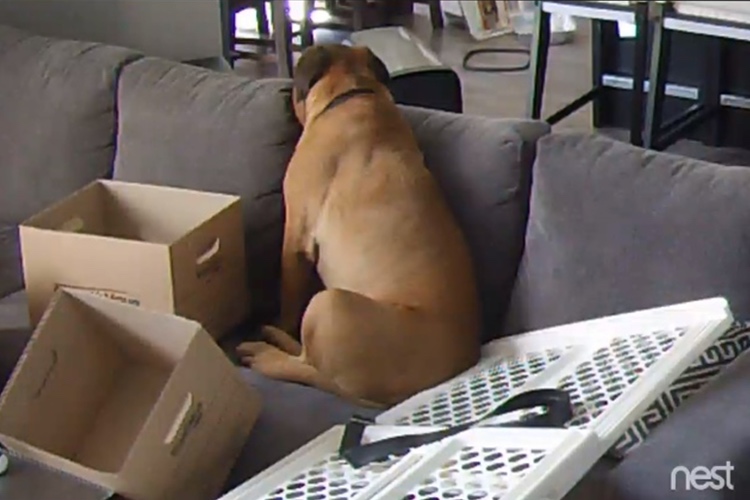
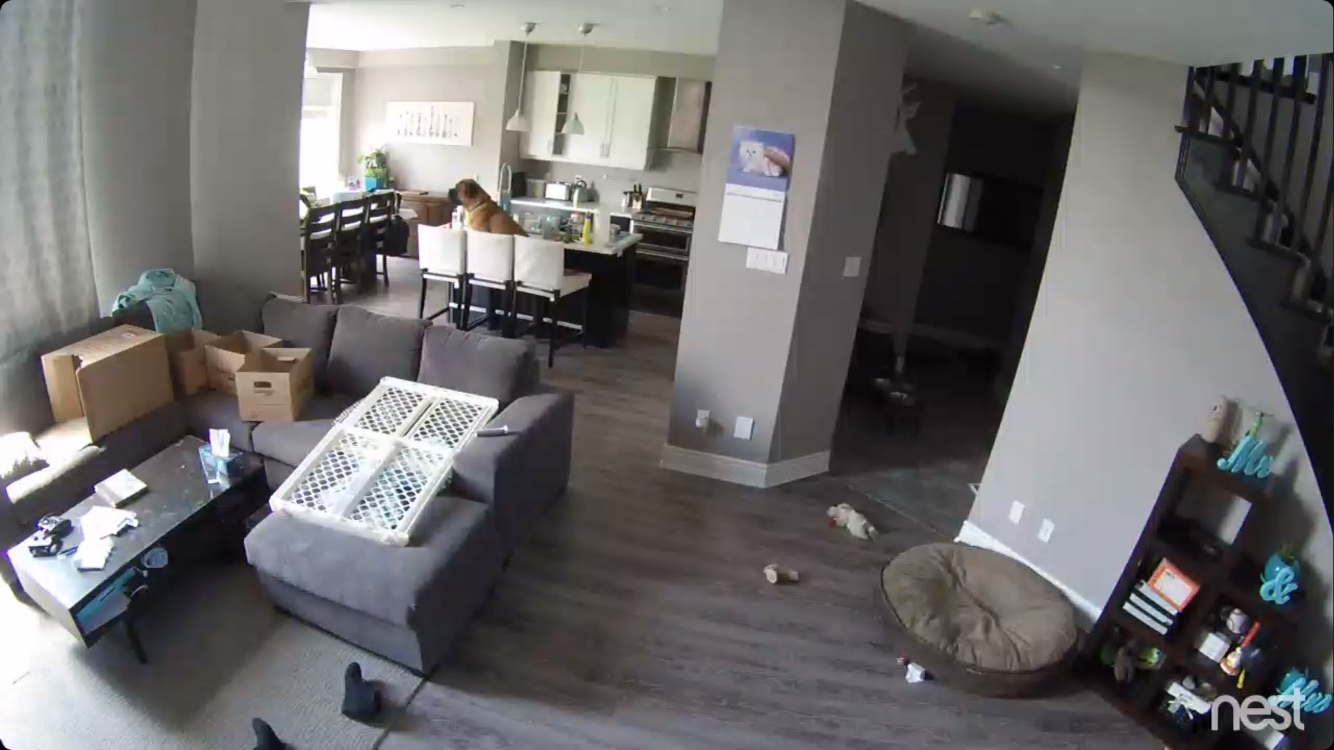
Even at the Vidyard office, we have our own Nest greatest hits. Tom Karthaus, one of our Account Managers has a Nest cam, and before finding a more reasonable solution for controlling his curious pooch Jackson, would share weekly still shots from his Nest cam, including:

Jackson breaking through his meager barrier and using it as a bed… on the couch.

Jackson - Couch

And Jackson making himself at home on the kitchen island.

jackson - table

Jackson has since been confined to a more reasonable space in the house that he cannot so easily escape from, so sadly these updates have dwindled. But, for a brief few weeks, knowing that at any given time Tom’s dog could be doing something completely ridiculous, and we could see it, brought an immeasurable amount of joy to the dog lovers in the office.

Content like this goes a long way to reinforcing why your product is so important. If your audience is willing to capture themselves using your product, and enjoy it — whether it’s dancing dogs or foiled break-ins — you get free marketing in exchange for validating your customers loyalty by sharing their awesome moment with the world.

User-generated content is meant to be win-win. Just ask this dog:

The post Dancing Dogs and Foiled Burglars – The Secret to Nest Cam’s YouTube Channel appeared first on Vidyard Video Intelligence Platform.


from
http://redirect.viglink.com?u=http%3A%2F%2Fwww.vidyard.com%2Fblog%2Fdancing-dogs-foiled-burglars-nest-youtube-channel%2F&key=ddaed8f51db7bb1330a6f6de768a69b8
Thursday, August 11, 2016

Video Marketing How-To: YouTube vs. Your Website

Hello, and welcome to another episode of Video Marketing How-To! This week we want to tackle a question that comes up often — whether your video should live on your website, your YouTube channel, or both!

First thing’s first is understanding that YouTube, alone, isn’t a video strategy. You need to be using both YouTube and your own website as part of your video strategy, but there is definitely a difference in what each channel means to your business.

Your videos on YouTube can have a variety of objectives — awareness building, generating subscribers, and driving traffic back to your website. Videos on your website can similarly have multiple objectives, from teaching customers about your product to generating leads, but one important distinction is the final destination. YouTube should drive traffic to your website. Your website should keep people there as long as possible, and move them through the buying funnel.

For YouTube, focus your attention on content you wouldn’t normally have gated. Assets that are top of funnel, and not too product focused. Anything you need to have a prospect fill in their info for, like full webinars, or lead generation content isn’t something you should have available to everyone.

That said, YouTube is a great place for hosting your blog content, company culture content like holiday videos and memes, and of course your campaign content. Just make sure you always use the description and YouTube annotations to drive viewers back to your website to take the next step.

Once prospects are on your website, you’ll want to make sure your videos compel them to take action. Here you can host your feature-length webinars and gate this content, so you can use it as a lead generation tool.

Your more complex product-based how-to content can also live on your website, as hopefully people aren’t searching YouTube for deep support questions. Same goes for your event content — by all means, have a trailer on YouTube, but don’t give away the entire keynote series for free.

Together, your website and your YouTube channel are a powerful way of getting eyes and leads from your video. But, as a rule of thumb, if you’re not interested in giving it away, don’t put your video on YouTube.

Anything else is fair game, and will likely help you build a great YouTube channel subscriber base, but always make sure you’re using a YouTube annotation or call-to-action in the description to get people back to your site. YouTube views are nice, but leads are nicer! That’s all for this week, and definitely tune in in another few weeks for another episode!

The post Video Marketing How-To: YouTube vs. Your Website appeared first on Vidyard Video Intelligence Platform.


from
http://redirect.viglink.com?u=http%3A%2F%2Fwww.vidyard.com%2Fblog%2Fvideo-marketing-youtube-vs-website%2F&key=ddaed8f51db7bb1330a6f6de768a69b8

Wednesday, August 10, 2016

No More FOMO: Building a Modern Live Streaming Strategy

Your audience wants more live content. Whether your audience is prospects, customers, or even employees, they want more real, in-the-moment moments.

How do I know this? Because today, people want to feel like they’re a part of something, they have a fear of missing out (i.e. FOMO). Not only that, they’re also dying for content that’s authentic, something less fabricated than a meticulously planned out video set.

We all are.

Why, hello there live streaming! But wait, not the complex conference live stream where you have to hire a whole other production team … but also the modern live stream: any sort of live event caught on video in real-time.

In a recent post, we spoke all about the technology behind live streams … for all different types of live streams. Here, we’ll dive into how to make the most out of your production with an impressive strategy to back up any live stream effort.

But first … When Should You Live Stream?

Before we dive into the depths of the live streaming black hole, let’s take a step back and look at all the ways you might use live streaming today because:

  1. it’s use has expanded way beyond streaming your company’s user conference, and
  2. your strategy may vary somewhat, depending on which approach you take.

Most live streams fall into one of the following four categories:

  • Event: conferences or webcasts
  • Product: updates, launches, or live demos

  • Company: behind-the-scenes or company announcements

  • Customer: support or additional touch points

Building a Strategy for a Successful Live Stream

Now that you’ve had a high-level overview of where you can utilize live streaming, it’s important to set a dedicated strategy for your live stream efforts. Of course, the typical strategic components that exist for any marketing activity also exist for a live stream production, like:

  • What is the goal? There’s no sense in starting any marketing initiative if you haven’t defined success. Are you trying to get 300 more MQLs? Or are you hoping to boost blog subscribers? Or maybe even increase engagement with your employees?
  • Who are you targeting? Knowing this ahead of time will help you tailor your approach so it’s hyper-relevant to a subset of your audience instead of a wishy-washy, generic message sent to a broad audience.
  • Why should it be a live stream? Understanding why this medium is the right approach to reach your goal and your target audience will help you get buy-in from all involved parties. Not only that, it will help you pinpoint great opportunities for live streaming and avoid getting involved simply because it’s a “hot medium”.
  • How will you promote it? Based on the goals you want this live stream to achieve and the audience you’re going after, how will you get it to them? Where do they hang out online (or even offline)? And how will you create a sense of desire and urgency so (a) register for the live event and (b) they actually attend?

In addition, you’ll also want to consider those aspects unique to live streaming like:

  1. How will you keep your audience engaged?
  2. How will you extend the life of your live stream?
  3. How will you capture leads from your live stream?
  4. How should you measure a live stream’s success?

Let’s dive more into these attributes!

1. Increasing Audience Engagement with Live Streams

An in-person, live event has multiple opportunities to participate. There’s time to ask questions or engage in conversation directly with speakers or company leaders. In the case of a personal demo with a sales rep, “audience members” can tailor the direction of the conversation and choose where to five deeper.

This is a lot more difficult when your audience is spread across different geographies and sitting behind screens. But if you can’t engage them with these supplemental activities they would get in-person, they’re definitely going to be more likely to drop off.

So how can you achieve the same level of engagement in a live video? Offer engagement opportunities, that’s how. The most popular are:

  • Polling the audience and sharing data in real-time
  • Participating in audience discussion or social chats during the broadcast
  • Offering resources to reference or download throughout the livestream

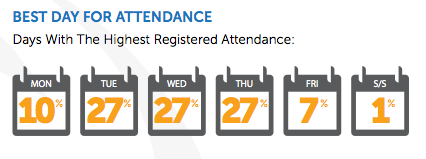
And remember, get started on the right foot by hosting your live stream on a day that’s more likely to have higher engagement from the get go. This is likely in the middle of the week — Tuesday, Wednesday, Thursday — according to a recent ON24 research study.

best attendance day webinars

2. Extending Live Content Beyond Now

The main attraction to any live stream is that it is literally live. It’s exciting to join a community online and learn something new together or witness a great new product release for a company you love with other people who feel the same. People all over the world can tune in together from the comfort of their own office or home and participate in discussions the same was as if they had flown halfway across the world.

Cool, no?

But the truth is, if you don’t find a way to leverage that content after the live event is over, you’re missing out.

Just think: if your CEO spent time to prepare an inspirational talk about the vision of the company, you better find a way for that to be accessible afterwards as well. If your annual user conference brought in 20 speakers and live streamed all the sessions, don’t you want all that great content available on your website for future consumption?

Yeah, you do!

Make sure that any time you’re live streaming, that you’re also recording the video so you can use it at a later date. And remember to build a post-event promotion strategy and/or email follow-up to send this recording out and increase exposure.

3. Capturing Leads from a Live Stream

Best practice says that events are the major place you would utilize live streams as a lead capture initiative. I would tend to agree. Any of the other three types are either too early or too late in the funnel (or post-funnel) to be gating. Of course, I’ll add the disclaimer that each situation is different!

So how will you actually capture those leads?

Brilliant question. There are five main ways:

  1. Pre-roll: A pre-roll lead capture involves a full form or email gate immediately after the viewer clicks play.
  2. Teaser: A teaser lead capture is when you show a clip of the content and then offer an in-video email gate or full form.
  3. Post-roll: This is a full form or CTA button after the video finishes playing.
  4. Parallel: A parallel lead capture is when a form is shown beside the video as the video continues to roll.
  5. Re-direct: A redirect involves simply redirecting the viewer to another area of a landing page — or entirely different page — to complete the next action. This would happen at the end of the live stream or recorded live stream.

lead capture video

Any five of these methods will be a great way to generate additional leads from your live stream.

Get the Guide

The Comprehensive Guide to: Using Video for Lead Generation, Scoring & Nurturing

Get the Guide

4. Measuring Live Stream Success

What gets measured gets done. Right?

Obviously, the first step in measuring your live stream success is to know what your goals were at the outset. But generally speaking, you probably want to move away from benchmarking yourself against number of views and move towards more in-depth analytics indicative of a greater purchase intent, engaged employee base, or active customers.

To measure your live stream’s impact, look at metrics like:

  • Attendance numbers, registration numbers, and attendance to registration ratios
  • Attention span, how much was watched, and where viewers started to drop off
  • Long-term recorded views days and weeks following the live event
  • Other metrics specific to your goals like MQLs generated, employee engagement, influenced pipeline, etc.

Remember, when you’ve built out a brilliant live streaming strategy, don’t forget to check out this post that Zack wrote on what you need to make your live stream come to life:  Getting Started with Live Streaming.

The post No More FOMO: Building a Modern Live Streaming Strategy appeared first on Vidyard Video Intelligence Platform.


from
http://redirect.viglink.com?u=http%3A%2F%2Fwww.vidyard.com%2Fblog%2Fbuilding-modern-live-streaming-strategy%2F&key=ddaed8f51db7bb1330a6f6de768a69b8